

A printing company production manager recently asked us about best practices for cutting paper on guillotine cutters. He writes, “I have a few people doing paper "their" way. I want to come up with one standard that everyone uses. I know there is a right way and a wrong way of cutting paper. However, I am thinking that some of my ways are incorrect.”
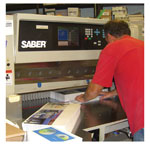 It sure sounds like a simple task—find published standards on an operation performed by tens of thousands of printers and binderies daily. The purpose of standards is to define expectations, but whose expectations are we talking about? Ultimately it’s the customer, expecting to receive a satisfactory looking print job.
Therein lies the problem; a multitude of printers with millions of customers, with an equal number of expectations! We know they all expect ‘great’ results on their job. So how do we narrow that big universe of expectations down to a simple standard on cutting paper?
Let’s break it down. We can’t manage results, only activities, in this case the activities of the guillotine operator. Thus we have job descriptions to tell an employee what their duties are. Then we have performance standards to tell the employee what results are expected for a specific duty, and how that duty is to be performed to get those results. It is probably safe to assume that one or more of the cutting methods mentioned by our reader are causing problems, otherwise the question would not have been asked. You’ve probably had similar discussions in your own shop.
To get to the heart of the matter, let’s work backwards from the problem. We can ask, “What are some signs that the paper cutting is not being done correctly?” From those answers you can start to compile a list of standards.
Here for instance, are five signs that paper cutting practices at a typical commercial printer could be improved:
- While cutting a print job you notice the press register seems to vary but upon closer inspection you find the paper is sometimes square and other times not. The paper was trimmed on the guillotine before going to press. The press registered precisely to the gripper and side lay but the inconsistent, out-of-square sheet makes it difficult to maintain register on the cutter.
- Register on the folder varies when running a trimmed brochure.
- The pressmen are complaining about hickeys on the stock you cut for them.
- The press stops frequently due to mis-feeds, short sheets, wrinkled or bent sheets when guillotined paper is used. Sloppy jogging, stacking or handling can cause this.
- Double sheets from your trimmed paper frequently stop the press, folding machine or other bindery equipment. This is often the result of trimming with a dull cutting knife.
These are examples of unacceptable results, so now we have to create the standards (and the related best practices) that will generate acceptable results. What’s unacceptable in your shop may be perfectly OK in other, so the ideal standards should be custom tailored.
Using these 5 warning signs above for example, we might apply the following practices to the cutter operators’ job:
- Before cutting, all printed sheets should be checked that the image is parallel to the gripper. (Eliminates mis-register from unit to unit when cutting.)
- Use correct clamp pressure for the stock being cut. (Use of manufacturer’s recommendation combined with your experience eliminates guesswork.)
- Paper trimmed for press must always be cut following these sequences [insert your preferences.] Polar-Mohr, for instance, has recommended cutting procedures for halving a sheet or for cutting 4 out. These can be tailored to your bindery operation. (More on this next week.)
- Paper trimmed for press must always be back trimmed (final cut is on the back, or flat side of the knife) using the following sequences. (Reduces hickeys on press.)
- When trimming paper for the press, discard the bottom sheet from the cut lift. (Reduces misfeeds from bad sheets.)
- Always use a sharp knife. (Eliminates double sheets from a dull knife.)
We could continue to drill down to discover more of what needs to be done, every time, to produce the desired results. Such an exercise could generate a lengthy discussion about who is responsible for what, and when. Getting back to our reader’s original search for best practices; how then, do we know if we have good standards and practices? If we have good, acceptable results every time the standards are used, then you have a good set of standards and practices.
If your paper cutting is not at the root of any problems, then you have good cutting standards. If some printing or bindery problem can be traced to a cutting practice, then it’s time to revise the practice and see if the results change.
Don’t fret; there are some good industry practices that we can use as a starting point for your own personalized standards. Next week we’ll take a look at specific techniques for cutting a sheet in half. Sounds easy, right? Well it is, if you get the results you expected.
As always feel free to share your experiences and suggestions below.