

Is the subject of packing boxes in the bindery a topic not worth your time? If you think it’s trivial, we promise it will eventually cost you.
How to Pack a Box is an important lesson to impart on your employees.
After all, customers are paying a lot of money for the jobs produced, so packing it properly should certainly be considered as part of the finished product. What good is the weeks of work put into a job if it goes out the door looking like a mistake? Sloppy packing jobs can give the perception that you did a sloppy job elsewhere as well and have your customers looking for the smallest error.
So, Here’s how you should pack a box and make it look like the job was worth every penny the customer has paid. In that spirit, here are some basic tips and rules of thumb about how to pack a box...and keep your customer happy.
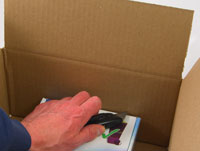 Use quality boxes for shipping; don’t get cheap, especially when shipping individual boxes via any popular ground or express air services.
- Pick the right size box for the job. Typically you’ll want the box to be ¼” larger than the size of the contents. For instance an 8.5 x 11 sheet would go into a box 8.75 x 11 ¼” or 11 ¼ x 17 ¼” by whatever height is needed.
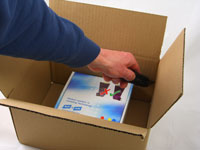 If you don’t have the right size box, cut it down as shown. 1) Score the box with a knife just above the edge of the packed material. 2) Cut the 4 corners of the box from the score line up as shown.
- Fill any voids with packing material to avoid crushing and to keep the contents from shifting. This applies to any box you pack, whether it’s original size or cut down to size.
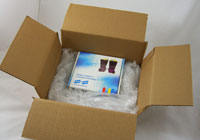 Tape all 3 seams when shipping individual boxes, especially if they weigh more than a few pounds.
- Keep the box weight down, no matter what the shipping companies consider acceptable. What’s too heavy? For printed material you’ll probably want to limit boxes to about 50 lbs. For heavier boxes it’s wise to consider extra heavy corrugated or doubled up boxes. (Too heavy, and the box may arrive barely resembling a box anymore and with the jobs inside scuffed with lots of bent corners.) Of course if you’re palletizing the boxes, weight isn’t as critical as when shipping individual boxes.
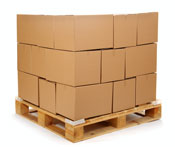
- When palletizing, stack boxes on each layer so you can alternate layers (shown below left) If you must stack without alternating, as when using square boxes, use sheets of chipboard or paper between every layer to stabilize the pallet. Stretch wrap combined with strapping is a good idea too if the pallet weighs more than a couple hundred pounds. Without securing boxes properly you can have your carefully packed boxes spilling all over the truck trailer.
When you consider the lifetime value of a customer, the losses from a sloppy or damaged box can be immense. If for instance, that first order of business cards from a new customer arrives on his desk broken and dinged, do you think you’ll ever get that order for 10,000 color brochures, let alone future years worth of possible orders? You never get a second chance to make a first impression. Whatever it is you’re printing and shipping, the lowly box and the care that goes into its packing can make or break your relationship with that customer.