

The problem of static in the bindery and press room is a complex subject. Prior to the age of digital printing equipment a static problem typically reared its head in the cold, dry winter months. Today, modern copiers and some digital presses are subject to static problems year-round, and the increasing complexity of printing and finishing equipment means there is simply more opportunity for the creation of static charges.
The lower relative humidity of winter creates an environment where static charges don’t dissipate as easily as they do with ‘normal’ relative humidity in the 40-50% range. That’s because moisture is a conductor. Less moisture in the air means there is nothing to carry away the electric charge that is building up. When a static charge in paper builds up, sheets will stick together, resist registering, refuse to enter the fold plates, or just won’t go where they’re supposed to go, whether on the folding machine or other bindery equipment.
The best overall preventive measure is to maintain the relative humidity somewhere in the normal range by adding humidifying equipment to the heating and air conditioning system. Yet even if you manage to work in an ideal environment, static problems can still arise.
Engineering specialists in static tell us that determining where the static is created is the first step to fixing the problem. In an ideal world an engineer would come in with a static meter and find the culprit. Then you apply the fix, such as ionizing air nozzles or static neutralizing bars.
In our real world, the situation is usually that an operator has a skid of brochures next to the folder, static has shut down production, and the truck is coming at lunch time. That’s when all the home made fixes come in to play. So while your company is contemplating the preventive measures, here’s a quick tip you can try the next time static has you down.
This one comes to us from Todd Summers, 2nd Shift Foreman for Nittany Valley Offset in PA. Summers has been successfully combating static with this technique for the last 12 of his 18 years in the industry.
 Grab a couple sheets of uncoated offset stock, preferably 70# text weight or lighter.
- Cut it at least 2” wider than the folded sheet and at least 1” shorter than the fold.
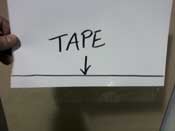
- Attach a strip of clear packing tape to bottom of sheet, (photo at right) half on the sheet, half exposed, ensuring there are no wrinkles in the tape.
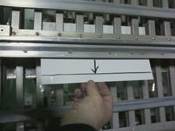
- Slide the sheet into the open fold plate, (below left) positioned where the folded piece is entering the plate. Carefully fold over the exposed tape and attach to the fold plate. Lock the fold plate in as you normally would.
 If you are doing more than one fold, repeat this process for each fold plate then start running your job. According to Summers, it seems that static dissipates once the sheet enters the fold plate and brushes the uncoated stock. Although Summers has used this primarily on MBO and Stahl folders, it should work on any folding machine. He’s also used the same technique on the feed board of sheet-fed presses.
As the specialists like to remind us, static is very complex. (You can find more resources on this topic here in a related article on static cures.) The pressroom and bindery have hundreds of potential points of static creation—basically any point where two unequally charged surfaces come together and pull apart. This can be paper and/or machine components. Proper grounding of equipment is also important.
What works for one job may not work on the next one because the point of static creation might have changed, thus the point of static elimination might have to change. So when you’re under the gun to get that job out the door, remember to pull out your little black bag of quick bindery tips. As always, feel free to share your ideas below!